
Trigger Warning: Sexual Assault, Gender Based Violence (GBV)
I watch a lot of movies and television shows. I love having something running in the back at all times. However, the one show I have been wanting to watch but haven’t been able to get myself to is Delhi Crime. While I’ve heard only good things about this show, the only reason I put off watching it is that I knew all the emotions it would bring out in me. Finally, I recently started the show.
The first season of Netflix’s Delhi Crime focuses on retelling the events that occurred in December 2012, when a young woman was brutally gang-raped, beaten, and tortured in Delhi. The physical assault on her body was so gruesome that after weeks in the hospital, she passed away from the injuries.
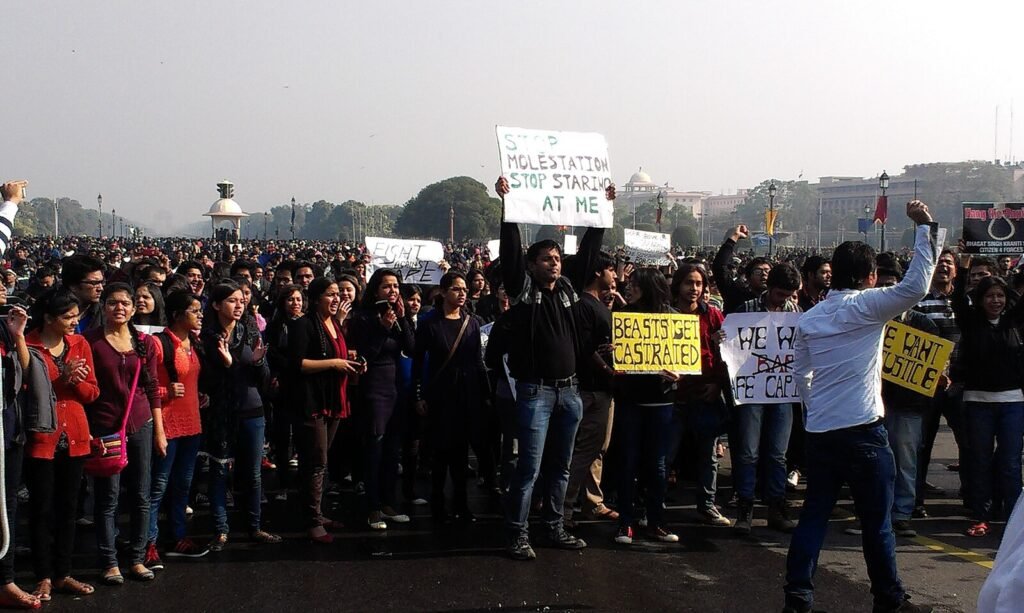
I think about this incident a lot – not just because of how absolutely horrific it is, but also because I remember landing in India a week after this to visit family. I remember seeing the state the country was in: protests in every city, citizens demanding justice, and discussions everywhere about how women deserve better.
However, things slowly started to die down. The court case went on, people went back to their lives, and soon, Jyoti Singh was mostly forgotten, along with every other victim of rape.
But more than that, the violence against women hasn’t really decreased. It hasn’t become much safer for women.
Seven years after Jyoti Singh’s death, Priyanka Reddy was gang-raped and strangled to death in 2019. Twelve years later, in 2024, a young woman in Kolkata (whose name has not been released to the public) was raped and killed. And these are just two of hundreds of rape cases that the media have picked up, and just two of the thousands of rape cases that happen around the country each year.
New laws might have been brought in, but that hasn’t stopped the fact that even now, an average of 86 rape cases are reported daily. This is a horrendous statistic, and it doesn’t even account for the number of cases that go unreported. Amendments and court hearings haven’t changed the fact that victim-blaming and the normalization of deep-rooted misogyny are still prevalent.
Going back to Jyoti Singh, we can see this mentality in the BBC documentary India’s Daughter, which attempts to shed light on what happened to Jyoti Singh and how people close to the case reacted to it. This documentary was supposed to be released in 2015 on International Women’s Day. However, the government of India decided days before to ban it, citing that some of the comments made by people featured in the film, specifically one of the convicted criminals, could “cause public disorder.”
The irony of this is how concerned the government supposedly was about public disorder, when none of that concern or safety is shown towards the women who are victims of rape and gender based violence daily.
Ten years later, India’s Daughter is still banned throughout India. There’s still an attempt to cower away from the reality, which is that even after a young girl was raped and murdered, the convict who was interviewed showed zero guilt, and the lawyer who defended the criminals went out of his way to blame the victim.


The disheartening part of this censorship is that all it does is try to hide a truth that women have to live with daily. Women are constantly told to watch what they wear, not to stay out late, and to live every single moment with fear and caution. Yet none of this stops men from speaking and thinking as those in this documentary do. Censoring it does nothing but make us all shy away from the truth: that the problem is not in how we dress or which roads we decide to take a stroll on past sunset, it’s in the deeply entrenched misogyny that we need to destroy.
This misogyny shows up everywhere in daily life. It’s in the movies that come out, which glorify harassing and stalking women until they’re forced to fall in love with the man. It’s in the way we teach girls that “boys will be boys,” excusing boys’ behavior rather than teaching them to be respectful. It appears in the way that, when a woman files a case against a rapist, people will automatically say she’s lying or focus only on how “rape allegations can ruin a man’s life.” This misogyny isn’t something that has appeared out of thin air. Instead, it’s entrenched in the patriarchal culture that has been accepted and promoted for generations.
Thirteen years ago, it was Jyoti Singh. Six years ago, it was Priyanka Reddy. Every single hour, it is a victim whose story we might never even hear about. But rather than letting this cycle go on, where a case is highly publicised for days or weeks, only to disappear then, it’s high time for real change. From the everyday culture in families and the media all the way to the lack of a proper structure as to how rape cases are handled, there’s a lot to reform. The only way we can do this is by acknowledging that misogyny is the root cause of these crimes – not a side effect or symptom.